

Ever wondered how long you might have to wait to see your 3D creations come to life? Let’s dive into the fascinating world of 3D printing!
The time it takes for a 3D printer to complete a project depends on various factors, including the object’s size and complexity. Small prints can take just minutes, while larger, intricate designs might take days.
But that’s just the tip of the iceberg! There’s so much more to uncover about what influences the timing of your 3D printing projects. Stick around as we delve deeper into each factor that plays a role in print duration.
3D printing time depends on object size and complexity.True
Larger and more complex objects require more layers, increasing print time.
What Factors Determine 3D Printing Time?
Unlock the secrets behind what affects the speed of 3D printing projects.
3D printing time is influenced by factors such as object size, complexity, layer height, printer technology, and material type. Smaller, simpler objects typically print faster than larger, more intricate designs. The choice of technology and materials can also significantly impact the duration of the printing process.
Object Size and Complexity
The size and complexity1 of an object are primary determinants of 3D printing time. Smaller and simpler objects can often be completed in less time compared to larger or more detailed designs. For instance, a simple keychain might take just 30 minutes, while a complex figurine could require several hours. This variation is due to the increased amount of material needed and the intricate detailing required for complex designs.
| Object Type | Estimated Print Time |
|---|---|
| Keychain | 30 minutes to 2 hours |
| Figurine | 4 to 12 hours |
| Large Sculpture | 12+ hours, up to days |
Layer Height and Resolution
Layer height significantly affects print time. Smaller layer heights produce finer details but require more layers, thus increasing print duration. In contrast, larger layers reduce detail but speed up the process.
| Layer Height | Detail Quality | Print Speed |
|---|---|---|
| 0.1 mm | High | Slow |
| 0.3 mm | Medium | Moderate |
| 0.5 mm | Low | Fast |
Printer Technology and Speed
Different printer technologies inherently operate at different speeds. For example, Fused Deposition Modeling (FDM) printers generally work slower than Stereolithography (SLA) printers, especially for complex models. SLA printers can scan a whole area at once, making them faster for certain tasks compared to laser point-molding techniques in FDM printers.
Material Type
The material used also impacts the print duration. Materials like PLA usually print faster than more durable options like ABS or nylon. This is because PLA requires lower temperatures and simpler processing, making it a preferred choice for faster prints.
Infill Density and Wall Thickness
Higher infill density increases structural strength but also requires more time to print. Similarly, thicker walls provide more robustness but extend the printing time. Adjusting these parameters can help balance between desired strength and print duration.
To further refine your printing process, consider utilizing software to estimate time based on your specific design and printer settings. These estimations provide a realistic expectation and help in optimizing your project planning.
Smaller objects print faster than larger ones.True
Smaller objects require less material and detailing, reducing print time.
PLA prints slower than ABS material.False
PLA prints faster due to lower temperature requirements and simpler processing.
How Does Object Size Influence Print Duration?
Curious about how object size affects the duration of a 3D print? Dive in to explore more!
Larger objects typically take longer to print due to increased material usage and complexity. The time varies significantly based on the object’s size, ranging from minutes for small items to days for large ones.
Understanding the Basics
The size of an object is one of the primary factors influencing 3D print duration. Generally, larger objects require more material and longer printing times. This is due to the increased number of layers needed to construct the object, as well as potential intricacies in its design. For example, a simple keychain might take just 30 minutes, whereas a full-scale model of a human head could take upwards of 24 hours.
Breaking Down Print Time by Object Size
Small Objects
- Advantages: Quick to print, typically taking between a few minutes to a couple of hours.
- Examples: A simple ring or a small gear.
- Considerations: Ideal for rapid prototyping and testing designs.
Medium-Sized Objects
- Advantages: Balance between detail and time, usually taking 4 to 12 hours.
- Examples: Phone stands, miniature sculptures.
- Considerations: Suitable for parts that need moderate detail without excessive print time.
Large Objects
- Advantages: Capable of detailed and full-scale prints.
- Examples: Full helmets, large vases.
- Considerations: May require days to complete and often involve significant planning and setup time.
Influences on Print Time Beyond Size
While size is a significant determinant of print duration, other factors play crucial roles:
- Complexity: More intricate designs extend print times due to additional layers and details.
- Layer Height: Finer layers offer better resolution but require more time.
- Infill Density: Higher densities increase strength but also print time.
Real-Life Applications and Examples
Let’s look at some real-world instances:
| Object | Size Category | Approximate Print Time |
|---|---|---|
| Keychain | Small | 30 minutes |
| Helmet | Medium | 8 hours |
| Sculpture | Large | 48 hours |
In summary, while object size is a critical factor in determining print duration, considering other elements like complexity and material can provide a more comprehensive understanding. Exploring these aspects can help optimize your 3D printing process2 and manage expectations effectively.
Larger objects take longer to print due to more layers.True
Larger objects require more layers, increasing print time.
Small objects always take less than an hour to print.False
Print time varies; some small objects may exceed an hour.
Why Does Printing Technology Matter?
From crafting intricate designs to building rocket parts, printing technology shapes our world in remarkable ways.
Printing technology is crucial as it dictates speed, precision, and the ability to produce complex designs. Different technologies like FDM, SLA, and SLS offer varied benefits, affecting efficiency and application scope in industries from healthcare to aerospace.
Exploring Different Printing Technologies
Printing technology is not a one-size-fits-all solution. Each method comes with its unique strengths and weaknesses, which are pivotal depending on the application.
-
Fused Deposition Modeling (FDM): Widely used due to its cost-effectiveness and versatility. FDM is ideal for prototypes and simple structures but may lack in achieving high detail or strength needed for industrial applications.
-
Stereolithography (SLA): Known for high precision and smooth finishes, SLA is frequently used in industries where detail is paramount, such as dentistry or jewelry making. However, it can be more expensive and slower than other methods.
-
Selective Laser Sintering (SLS): SLS does not require support structures, making it suitable for complex geometries. It is highly favored in industrial applications like aerospace due to its capacity for strong, durable outputs.
| Technology | Strengths | Common Uses |
|---|---|---|
| FDM | Cost-effective, versatile | Prototyping, hobbyist projects |
| SLA | High precision, smooth finish | Dental models, jewelry |
| SLS | No support structures needed, durable | Aerospace, industrial parts |
Impact of Printing Technology on Industry
Healthcare Innovations
In healthcare, 3D printing has revolutionized the production of prosthetics and implants. SLA technology allows for the creation of bespoke dental implants with precise fitting, enhancing patient comfort and treatment outcomes.
Aerospace Advancements
Aerospace companies are utilizing 3D printing technology3 to produce lighter, stronger components, which helps in reducing fuel consumption and costs. This technology allows for rapid prototyping and testing of parts, leading to faster innovation cycles.
Food Production
In the food industry, 3D printers are creating unique textures and shapes that were previously impossible. The advancement in food printing4 not only satisfies aesthetic demands but also paves the way for customized nutritional products tailored to individual dietary needs.
The Future of Printing Technology
The future holds promising advancements as researchers continually push boundaries. Emerging techniques aim to reduce waste and increase speed, such as combining 2D printing with origami techniques. This innovative approach allows the manufacture of complex 3D shapes quickly and efficiently.
In conclusion, understanding why printing technology matters opens doors to exploring how these advancements can be leveraged across various sectors to improve efficiency and creativity.
SLA is ideal for industrial applications needing strength.False
SLA is known for precision, not strength, used in dentistry/jewelry.
FDM is the most cost-effective 3D printing technology.True
FDM is widely used due to its cost-effectiveness and versatility.
Can Material Choice Impact Printing Speed?
Ever wondered why some 3D prints are quicker than others? The material you choose could be the key!
The choice of material significantly affects 3D printing speed. Materials like PLA offer quicker print times due to lower melting temperatures and smoother flow characteristics, whereas materials such as ABS or nylon may require more time due to higher processing temperatures and potential for warping.
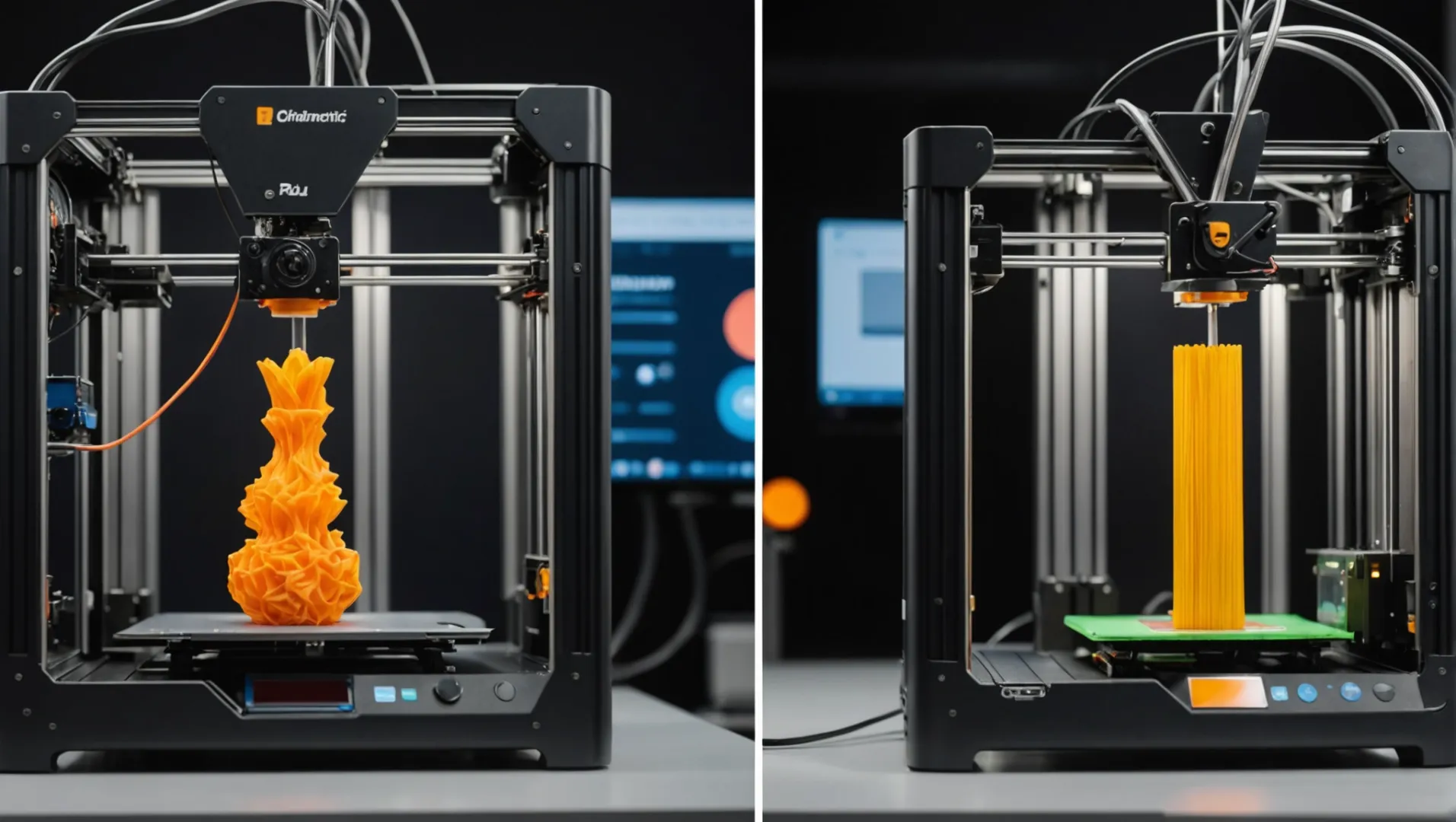
Understanding Material Properties
When selecting a material for 3D printing5, it’s crucial to consider its intrinsic properties, such as melting point, flow rate, and structural integrity. Polylactic Acid (PLA), for example, is favored for its low melting temperature and ease of use. It cools quickly, allowing layers to set faster and reducing overall print time.
On the other hand, Acrylonitrile Butadiene Styrene (ABS) demands a higher extrusion temperature. It requires additional time for layers to bond properly, often necessitating a heated bed to minimize warping. As such, ABS prints generally take longer compared to PLA.
Comparing Common Materials
| Material | Melting Point | Ease of Use | Print Speed | Remarks |
|---|---|---|---|---|
| PLA | Low | Easy | Fast | Ideal for beginners |
| ABS | High | Moderate | Slower | Needs heated bed |
| Nylon | Very High | Difficult | Slowest | Excellent for strong parts |
Advanced Materials and Their Impact
More advanced materials like nylon or polycarbonate offer enhanced strength but at the cost of speed. These materials demand precise temperature control and slower layer deposition to maintain print quality and structural integrity.
The Role of Composite Materials
Composite filaments that combine materials like wood or carbon fiber can also influence print speed. While they add unique textures and strength, they often require slower print speeds due to their abrasive nature, which can wear down printer nozzles.
Conclusion: Weighing Speed Against Quality
While speed is a significant factor, balancing it with print quality and material properties is vital. Opting for a faster material might save time, but ensure it meets the requirements for your specific project needs.
PLA prints faster than ABS in 3D printing.True
PLA's lower melting point and quick cooling enable faster printing.
Nylon is the fastest material for 3D printing.False
Nylon's high melting point and strength needs slow, precise printing.
Conclusion
Understanding the factors that influence 3D printing time helps you plan effectively and optimize your projects for better results.
-
Understand how object size influences 3D printing duration.: Basically, the thing that gets spread about a lot, is that using a larger nozzle size enables wider line widths, which leads to quicker prints. ↩
-
Learn effective strategies to enhance your 3D printing efficiency.: To make precise prints or to print with flexible filaments, you need to have the latest spring loaded drive block for your printer. The drive block is what … ↩
-
Discover how aerospace benefits from lightweight, strong 3D printed parts.: Read on to find nine key ways 3D printing is powering innovation across the aerospace industry, from design to manufacturing and beyond. ↩
-
Learn about innovations transforming food production with 3D printing.: The 3D-printed food method is quick, reduces prep time, makes efficient use of ingredients, and minimizes food waste (and, in turn, food … ↩
-
Discover how different materials impact 3D printing efficiency.: Ultimately, the optimum print speed will depend on many factors, such as the type of material, layer thickness, type of 3D printer, model design and complexity. ↩